


Week 9: "Mervie" & The Rhetoric of Electracy
- moniquemcbain
- Oct 26, 2024
- 6 min read
Updated: Nov 3, 2024

From: Oxford Languages online
Philosophically speaking, defining rhetoric is not as simple as researching its meaning in a dictionary. Embedded in any discussion of the role of rhetoric are considerations relating to who uses it, its purpose, where it is situated and what action it hopes to spur (Kenneth Burke). Central to rhetoric, however, is persuasion, specifically the tools of persuasion and their effects on audiences.
Certainly, the dictionary definition of rhetoric above does not ostensibly encompass multimodality, as new media means of rhetoric are not explicitly referenced. This does not strike me as unusual, particularly as multimodal forms of expression are actively evolving with the constant development of technology and in light of recent readings about the same in which authors Collin Gifford Brookes (Lingua Fracta: Towards a Rhetoric of New Media) and Gregory L. Ulmer (TELEtheory) in their treatments of multimedia/technology warn against limiting new media to the ideological confines of orality and literacy; instead, they suggest new means of conceptualizing technology's rhetorical production in terms of apparatuses and domains of effect. Ulmer specifically contends that the apparatuses of orality, literacy and electracy, his neologism that categorizes production in the digital domain (i.e. electracy ‘is to digital media what literacy is to print’), differ in practice, mode and institution, among others, as captured in his comparative diagram below:

From: Markelj, J., & Sundvall, S. (2023). Theming electracy: An interview with Gregory L. Ulmer. The International Journal of Research into New Media Technologies, 29(1). https://journals.sagepub.com/doi/full/10.1177/13548565231155078
Yet, despite every warning against doing so, I do see ways in which older frameworks comingle with or scaffold the new, and this was particularly evident to me in a recent news event in The Bahamas that seemed to have been resolved as quickly as it emerged (roughly a 'biblical' 3 days), I believe, due to the intersection of classical rhetorical forms with the semiotic tools of persuasion that are embedded in multimedia/technology. What follows is my understanding of those events and how the frameworks of orality, literacy and electracy possibly collide.
Speaking in terms primarily associated with orality, it can be argued that the kairos of the rhetorical situation, as captured by a local news station, OurNews, was as follows: An owner of a home for the elderly, Mermaid Knowles, was accused of taking ownership (legal and physical) of a resident's (Mrs. Ingrid Carey's) home, gaining power of attorney, and accessing other benefits through questionable means, without the knowledge of Mrs. Carey's next of kin, her granddaughter (Phillipa Carey), who works off island, and as such, left her grandmother (whom she considers her mother) in Knowle's care
( https://ournews.bs/grand-bahama-residents-support-woman-who-alleges-family-home-was-taken/ ournews.bs). While the event serves as the critical moment for rhetorical action, the widely circulated images of the resident who, as explained by her granddaughter, suffered from dementia and depression, also affords a possible punctum, borrowing from the vocabulary of photography as Ulmer does, for the public's overwhelming support - the punctum being a detail in an image that captures viewers' attention and evokes a powerful emotional response. What that detail is will vary from viewer to viewer.
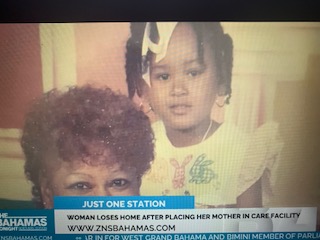

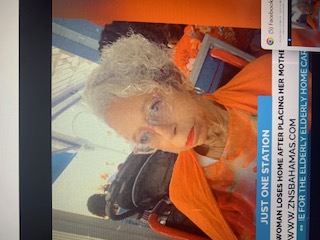


(Images are screenshots from ZNS Bahamas, The Bahamas Tonight, Northern Edition and from the Facebook post of granddaughter Phillipa Carey, moniker Philly Dash)
It can be agreed, however, that Mrs. Carey presented a powerful image that most likely resonated with the public as the pictures display a history of her loving care of her granddaughter (as in memory, a pillar of rhetoric), her aging and associated fragility (in a similar vein, arrangement), possibly all working to urge the public's need to protect her, even as they empathized with the issue and, perhaps, thought of the elders they esteem in their own lives and/or themselves being found in a similar predicament. As such, the images not only connected to the audience on the electrate axis of the affective in which there is joy and sadness, but also produced outcry from the public in the oral and literate axes of right and wrong and true and false, as the public experienced sadness, in the form of the secondary emotion of anger., in response granddaughter Phillipa Carey's plea for justice. The public also collectively determined that Knowle's defense of herself and actions in the news story is false, and set out to incite what is determined to be the right course of action (that is, the removal of Knowles from Mrs. Carey's home).
The rhetoric of electracy was then advanced in many forms, including memes, tik tok videos, and other formats, including even a spoken word poem and a song about the issue, all of which aim to characterize Knowles in a specific way and produce justice, a sampling of which is provided below:


Through these memes, Mermaid Knowles' surname is dropped, and her first name is reduced to a diminutive form, "Mervie." Using a pet name to refer to Knowles is an intentional rhetorical decision that strips away any element of respect or authority from her. In the memes, Knowles is characterized as a repulsive and wicked (as phonetically depicted in the first meme in an exaggeratedly Bahamian way) insect, as having more evil intentions than the devil himself in the second meme's imagined conversation, and is portrayed as prime subject matter for a Netflix investigative series for immediate release. A video in which "Mervie" tells her side of the story to news reporter is altered to reveal the public's views of her intentions, simultaneously silencing what is determined as her unacceptable defense of her actions:
(Source: Facebook page 242 in the know )
While all of the videos, memes, and commentary produced about the issue are simply too prolific to capture on this page, the presence of humor in a serious situation is not lost on me and, in fact, reflects Ulmer's contention that the joke is an intrinsic aspect of electracy, serving as a "textual structure" that organizes "exchanges of the symbolic code," and as a "false reasoning" that evades "the inhibitions and compulsions of reason and criticism" (Ulmer, 2004, p.74). These productions also exist in the Ulmer identified practice of entertainment.
However, of note is that there was also a resultant action external to social media, in the domain of orality, as a group of Bahamians staged a protest on the issue in front of Knowle's home for the elderly, simultaneously demanding the removal of Mrs. Carey from the home for the elderly and 'Mervie's' exit from Mrs. Carey's residential home. In that action, we see some overlap of frameworks, specifically how the figures/images of electracy were used to create arguments that then [re]emerged in orality, as protesters voiced their arguments in real time and televised news reports.

A theme eventually developed that aimed to prompt Mervie to do what the public determined was the morally correct action, which was to leave the home, returning it to its rightful owner. That theme was repeatedly expressed in the Bahamian vernacular, ensuring that there was no ambiguity in the message: "Come out these people house." The t-shirts in the picture above emphasize this message, and as an added touch, hints at the ties between new media and consumerism, though the image may just be that, an image only.
At the time of this writing, Mervie Knowles had agreed to vacate the home, legally and physically, demonstrating the power of social media to effect change, even as other information was brought to light, further proving the illegality (and immorality) of Mervie Knowle's action. It should be noted that the event has also generated adjacent conversations online that endorse popular opinions about the need for accountability in nursing homes and the role of government oversight in similar establishments. Experts, such as lawyers/financial professional have likewise chimed in, encouraging Bahamians to create clear legal documents, specifically wills and trusts, and ordinary Bahamians have offered personal expressions of pride in the power of the Bahamian people to rally around a cause and to effect change.
Nevertheless, I offer the caveat that this discussion represents only my limited interpretation of a very recent matter to make the case for electracy's overlap with literacy and orality. I also did not reflect on the situation of the event, which in this case was a specific island within The Bahamas, Grand Bahama, known to have its own set of core values, sociocultural norms and dynamics which some would say are distinct from those of Bahamians situated in the capital city and in other locations throughout the archipelago. This is important as some Grand Bahamians have suggested through online comments that the actionable portion of the outcry (the protest) would be less likely to occur in New Providence.
What can be concluded with little controversy, however, is that there are emerging stories online about who Bahamians are as people on personal, popular and expert levels, reflecting the inventive and creative MyStory narratives that Ulmer believes electracy is conducive to generating.

Comments